

Millbrook Adapts ACI in Challenging Times
Millbrook Medical Conferences upgraded an annual, flagship, national society conference to an astonishing virtual, interactive bank of education and sharing of experiences to 850+ delegates.

As COVID continued to restrict the amount of training and education that healthcare professionals were receiving, Millbrook Medical Conferences upgraded an annual, flagship, national society conference to an astonishing virtual, interactive bank of education and sharing of experiences to 850+ delegates.
A treasure hunt boosted engagement, industry interaction and competition. Content included ‘how-to’ tutorials, topic-specific sessions, acting scenarios and sponsor demonstrations. In addition, the event discussed difficult topics such as racial bias, sexism, and bullying head-on in new ways. The content will remain available online for new healthcare professionals as they join the specialty.
The British Cardiovascular Intervention Society’s three-day flagship annual scientific conference attracts approximately 1,000 attendees each year. Open to interventional cardiologists as well as allied health professionals, the meeting is the largest and most relevant educationally of its kind in the United Kingdom and the only focussed meeting offering a chance for everyone in this field of medicine, including industry, to network.
Leading up to January 2021, the British Cardiovascular Intervention Society (BCIS) was progressing as expected although this year, with the COVID pandemic still hovering, Millbrook was planning an e-conference with the hope that it might be able to have some faculty at a venue. As all event managers will have experienced, nothing is guaranteed during such a time.
Due to the huge spike in COVID cases over the Christmas period, it was decided, just three weeks before the conference was due to take place, that the conference should be postponed for three months. Most of the faculty and delegates were frontline workers and about to be transferred to support the ITU and respiratory physicians with the second wave. The Millbrook team knew that it wasn’t the right time for ACI to go ahead but recognised that the education was still very much needed, so should go ahead in spring.
Millbrook Medical Conferences (Millbrook) is the organising secretariat for BCIS and professional conference organiser (PCO) for BCIS meetings. Millbrook’s Managing Director, Fiona McDonald, was on the programme committee for BCIS’s ACI Virtual Experience, and therefore, was heavily involved in the topic selection, content creation and just as importantly, the delivery of the conference. Fiona’s previous experience as a medical secretary within the NHS and knowledge proved invaluable as Fiona was able to bring a fresh perspective to ACI.
The annual ACI (Advanced Cardiovascular Intervention) conference is part-funded by sponsorship from the pharmaceutical and medical device industry, and in return companies would traditionally have a booth within the exhibition hall, giving them the opportunity to network with delegates and generate new business. As such interaction was not possible virtually, Millbrook consulted with industry throughout the process to ensure the format offered value for money and ample opportunities to generate business. Through the process, Millbrook found that companies were not keen on the virtual format they had experienced at previous conferences and were struggling to engage with delegates at all. Posing a huge challenge for the PCO, Millbrook had to ensure that industry felt included and saw some return for their investment.
Millbrook thought up the idea of incorporating a ‘virtual treasure hunt’ to combat the challenges faced by industry representatives and ensure high engagement. Delegates were presented with various questions relating to every aspect of the conference, from the programme content to the sponsors and exhibition, and on-demand and live content.
Users were then directed to all areas of the e-conference to find the answers to the questions and for every correct answer they earned points. A public leader board was made available and the top three competitors had the opportunity to win an annual BCIS membership, worth up to £300.
The virtual treasure hunt resolved the issue of companies feeling like delegates were not connecting with their representatives and content. In addition, it added an element of fun and created a sense of suspense and competition to the e-conference. Overall, the virtual treasure hunt was a huge hit and received fantastic feedback from industry and delegates alike.
A prominent issue within interventional cardiology is the lack of women that work within the speciality, of all consultant cardiologists specialising in intervention, less than 6% are women. In response to this, BCIS created the Women in Cardiology Focus Group to explore and address the issue.
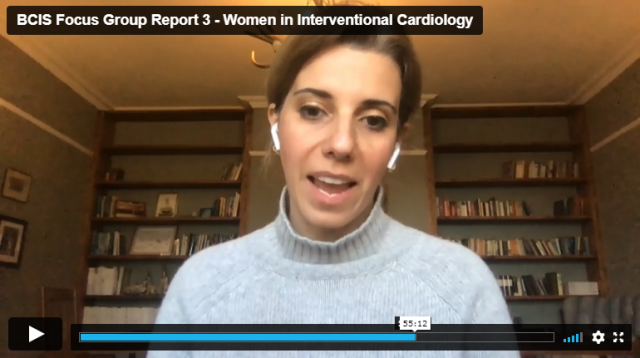
ACI 2021 marked one year since the group was created and for its debut group report to be presented to members. The President was keen to implement real change to address this, with Millbrook’s Fiona on the programme panel. A role-play session was created, there were three scenarios, each featuring a high-profile senior consultant cardiologist and a professional actor. The two were presented with a real-life scenario, whereby there is implied bullying, miscommunication, or sexism, and the two act out how they would behave in the situation. Regular time-outs were scheduled so both the cardiologist and actor could reflect on their behaviour and how they handled the situation, giving them the opportunity to analyse and improve as the conversations continued.
The videos were incredibly powerful, and the cardiologists involved said it gave a real insight into how to handle confrontation and how they can improve in their own scenarios moving forward. The sessions were praised by delegates for directly facing difficult topics and helping others to focus on the ‘softer-skills’ required for their roles, which are rarely taught and are essential for a high-functioning team.

The difficulty Millbrook and other PCO’s have experienced throughout the pandemic is how to take a three-day programme and create an engaging online experience with over 100 hours’ worth of content. Millbrook understands that people don’t have the same attention span for online-only events, but there was still so much to discuss that would be of high value to delegates. Originally, Millbrook was going to reduce the amount of content on offer and have live content over three half-days. However, there had been no education for a year, and so much had changed that Millbrook quickly realised the three days would be essential.
In total there were three tracks of content; one track was live, and the others were available on-demand. In addition, there was an exhibition hall, social media wall, chat forum, treasure hunt and much more. It was a risk to include so much information, but it was a risk that most certainly paid off, as Millbrook saw with the outstanding feedback received. The format allowed delegates to focus on the content they needed most, and the variety kept delegates engrossed.

The Results
Dr Gavin Galasko, ACI delegate and consultant cardiologist at Blackpool Teaching Hospitals NHS Trust, said:
“I don’t normally spontaneously volunteer feedback, but can I just say I thought ACI was excellent this year and that the virtual experience ran brilliantly.
“I thought it worked well and all the chairs did a brilliant job running each session virtually. I really enjoyed it. Well done everyone involved.”
Dr Shrilla Banerjee, chair of Women in Interventional Cardiology Focus Group and consultant cardiologist, added:
“Amazing three days! Thank you @MillbrookMed for transforming our #BCISACI meeting to a virtual platform to allow us to discuss important areas such as bias, INOCA, training issues, TAVI, stroke thrombectomy, OOHCA, trial data and Women in Interventional Cardiology!”
Dr Lavinia Gabara, cardiology fellow, commented:
“Fantastic news! #BCISACI has really taken things to another level.
“In addition to clinical up-dates and fantastic cases, sessions focused on ‘soft skills’, bullying, sexism and WIC…and I am still exploring! I think all cardiologists should check it out!”
Plus, on the first day of BCIS ACI, Science Pulse, a social listening tool designed to bridge the gap between journalists and scientists within social media platforms, tweeted that the top hashtags used by the scientific community in English tweets in the last 12 hours had been #COVID19, #BCISACI, #SARSCOV2, #EARTHDAY2021.
In addition, the more immediate impact of ACI Virtual Experience 2021 conference is shown by the analytics offered within the e-conference platform:
The adoption rate was particularly impressive. For many attendees, the conference registration is included within their annual subscription to BCIS and all content would be available on-demand after the event. With other ‘free’ e-conferences, Millbrook has seen an average of 50% adoption rate for a variety of reasons. To see such a high adoption rate is testament to the content included and promised to attendees within the lead up the event.
The ACI Virtual Experience 2021 also made history within BCIS for having the first ever all female panel discussing a session. Over the years, there had been many all-male panels, and over-representation of men within the faculty, but last year, ACI was different. Whilst there are far fewer women working within interventional cardiology than men, the programme group worked hard to ensure there was female representation across all sessions and including prominent roles within the conference.
In early December 2020, B.R.A.I.N (Barts Research and Advanced Interventional Neuroradiology) was run as a virtual conference for the first time ever. With the pandemic taking hold of the world, Millbrook Medical Conferences (Millbrook) transformed what was planned as a face-to-face conference in central London to an e-Conference.
The four-day e-Conference, B.R.A.I.N, took place from December 7-10 and was a real success. With only a three-month lead time, B.R.A.I.N reached a global audience of just under 900 delegates representing 35 countries.
Course directors and interventional neuroradiologists Dr Paul Bhogal, Dr Levansri Makalanda and Dr Ken Wong, approached Millbrook with the idea of organising the annual B.R.A.I.N conference.
The conference would welcome neuroradiologists, endovascular neurosurgeons and allied health professionals from all over the world. With a national and international faculty gathering under one roof to provide education on several topics, including stroke, aneurysms and new technology via in-person and virtual participation.
COVID-19 and government restrictions meant that B.R.A.I.N could not go ahead in-person as the trio had originally envisaged. Nevertheless, Millbrook Medical Conferences made sure that B.R.A.I.N 2020 still went ahead – but with a virtual format.
Millbrook utilised its dedicated web-based platform for the e-Conference, which offered a whole host of interactive features, whilst being user-friendly, eye-catching, and easy to access regardless of the user’s device and location. Sponsor exhibition pages, a social media hub and document libraries gave attendees access to a wealth of information and ensured continued engagement throughout the duration of the conference.
A chat function and Q&A boards were added to give two-way interaction for the delegates with the Q&A system moderated by Millbrook.
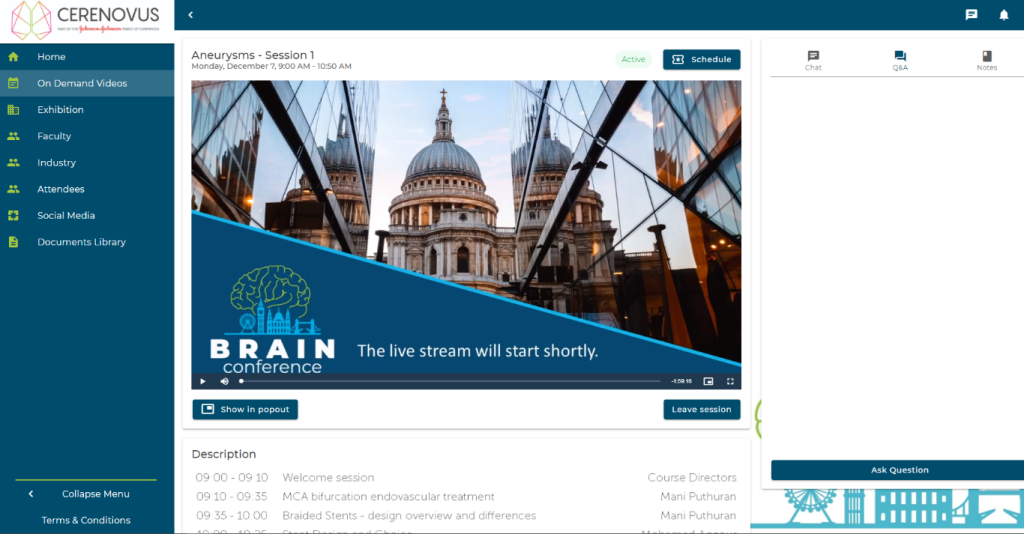
Millbrook worked closely with the 60-strong global faculty to ensure that they were all comfortable with the streaming platform and delivering live presentations. Millbrook preparations included arranging speaker briefings, creating training documents, and filming and editing 16 pre-filmed talks.
With more than 70 presentations spanning across the four days, each day focussed on a single topic, including stroke, aneurysms and embryology, phylogeny, AVM and DAVF. As the presentations were delivered by an international faculty comprising 60 speakers from 16 different countries, working across multiple time zones was pivotal to the success of the e-Conference.

In addition, Millbrook implemented a virtual green room for the speakers to access ahead of going live, which allowed them to familiarise themselves with the platform, ask questions, and prepare for the live conference itself. The virtual green room worked extremely well, putting the presenters and producers of the live stream at ease.
Commenting on the usefulness of the virtual green room, Dr Paul Bhogal, said:
“The virtual platform was so easy to access and navigate and the presentations were all very clear and streamed to perfection.
“Millbrook’s inclusion of a green room for virtual presenters to test before going live was an excellent addition.”

Good communication with the speakers was vital in the lead-up to the e-Conference, with Millbrook sending out reminders one week, one day, and one hour prior to going live, as well as obtaining back-ups of all presentations in case of any technical glitches.
As well as organising the e-Conference, Millbrook managed all the registrations, delegate queries, faculty and sponsor liaison and funding.
In the run up to B.R.A.I.N, Millbrook took over the @brainconferenc1 Twitter account and utilised its own @MillbrookMed channel to share engaging and relevant social media posts to build a sense of anticipation for the e-Conference. Millbrook leveraged email marketing, too, to encourage further registrations.
The e-conference received a wealth of positive feedback on both its content and format. The survey for the inaugural B.R.A.I.N conference was completed by 313 people.
The results show:
When asked what the best aspect of the e-conference was, one delegate said:
“High-quality lectures, with very interesting subjects. The possibility to watch the lectures at a later time is also warmly welcomed.”
Another delegate commented:
“The wide range of medical and technological advancements that have been presented in the context of case-based discussions was quite interesting for a foundation level doctor like myself.”
Other delegate feedback included:
“The best aspect was the availability to all students/doctors worldwide, online and free. Also, the organization was good and the topics, thank you.”
“Very organized, ease of asking questions, great selection of speakers.”
Taking to Twitter, one attendee said: “Fantastic conference guys, well done. Looking forward to 2021”, while another commented: “Great conference, excellent organisation!”.
Other comments included: “B.R.A.I.N @brainconferenc1 2020 was an amazing conference. I hope to participate it in person 2021!” and “Been the best virtual meeting of the year by miles, very well organised.”
Millbrook is looking forward to working with Dr Paul Bhogal, Dr Levansri Makalanda and Dr Oli Spooner for B.R.A.I.N 2022, which following the success of the e-Conference, will be held as a hybrid event.
The Imperial College COVID-19 Cardiovascular Conference was the first interventional cardiology educational webinar focussed on the presentation of COVID-19 in cardiac patients. With just a 10-day lead time and no funding, Millbrook produced a four-hour webinar comprising 27 presentations and 31 live speakers from the UK and around the world.
The webinar generated 5,600 unique live delegates worldwide. It’s since received 3,694 on-demand views – a total of 9,294 healthcare professionals having been educated by this endeavour. Moreover, the content helped shape the management of COVID-19 within cardiology globally, educating clinicians on the best way to treat and manage cardiac disease in the COVID-19 patient.
In response to the COVID-19 pandemic, a team of cardiologists at Imperial College London realised the need to share information on a global level to understand the best practices in managing COVID-19 in patients.
Millbrook, a recognised PCO with a reputation for leading cardiovascular conferences across the UK, was contacted on March 24, 2020 – a day after the country went into lockdown – to work in partnership with Imperial College to execute a global educational webinar.
The webinar would bring together leading practitioners from Europe and the USA to educate healthcare professionals on the manifestation of coronary artery disease in patients suffering from coronavirus as well as those patients with pre-existing coronary artery disease.
As the rate of infection was increasing rapidly, time was of the essence. Millbrook was advised that for the event to have any effect, it would need to take place before April 2, 2020, giving Millbrook a ten-day window to execute its first webinar.
The ten-day timeframe was important to the objectives and mission because the information regarding COVID-19 was very quickly becoming granular. Information needed to be shared fast and a pro-active approach needed to be taken to share experiences and help to shape the way clinicians around the world dealt with COVID-19.
Millbrook’s main objectives were to create an interactive, easy to join webinar with a global reach of healthcare professionals – in particular cardiologists, where respiratory care was going to be critical in saving lives.
Once live, the webinar needed to be highly engaging, visual and collaborative, allowing for audience participation and Q&A.
Millbrook’s role included marketing the webinar to generate a global audience, preparing a comprehensive programme, technical testing with all speakers and management of delegates. With an extensive programme, this technical webinar had to run seamlessly.
The four-hour programme featured four sessions, 27 presentations and 31 faculty. Whilst the programme focussed predominantly on experiences from Imperial College London which, at the time, was experiencing a high proportion of COVID-19 cases in the UK, the conference was a global collaboration.
The programme featured high-profile consultant cardiologists in New York, Minnesota and Milan, as well as the deputy clinical director of Nightingale Hospital Excel, which was preparing to accept its first patient at the time. This would be the first sharing of experiences between doctors in the UK, Europe and the US on how to treat the manifestation of cardiovascular disease in patients who have COVID-19.
Talks would compare the experiences of different countries in two ways, firstly by explaining the impact COVID-19 was having on their hospitals and cities, as well as comparing the approaches taken by governments and healthcare systems and how this impacted their approach and success in managing the disease. It was a race against time to save patients’ lives, so it was important to learn from doctors who had already been treating these patients before COVID hit its peak in the UK.
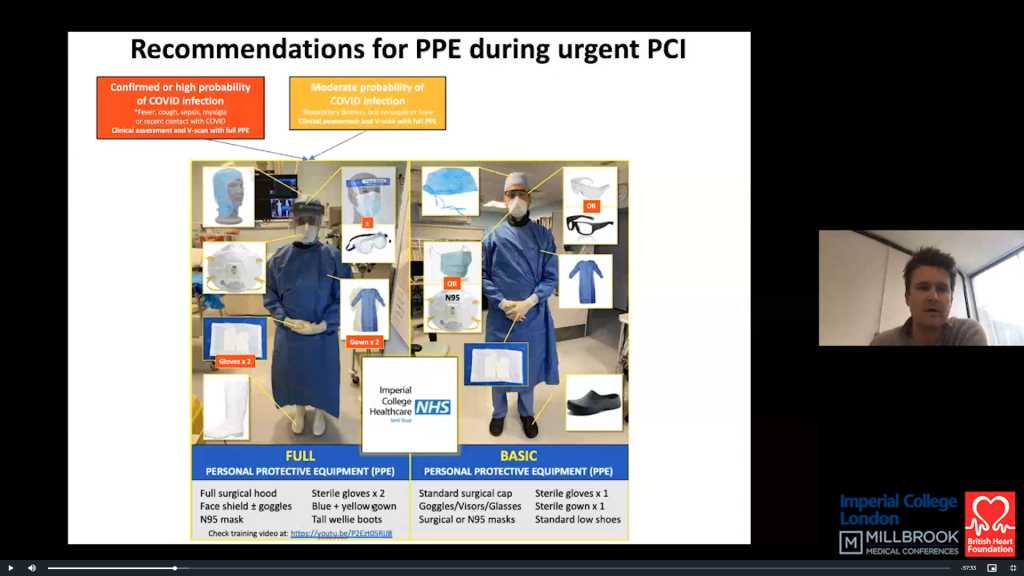
Due to the urgency of the situation, the nature of the information to be shared and the higher purpose of the event, no company or individual took a fee for the work involved. This also meant there was no budget for any aspect of the webinar. So, when Millbrook looked to select a platform for the webinar, Microsoft Teams was the obvious choice incurring no platform costs and able to accommodate the numbers of participants that were expected.
Whilst individuals could register for the conference ahead of the event, using Microsoft Teams meant anyone could join by clicking a single link. This removed all barriers to entry, helping to maximise the number of attendees, whilst also giving some visibility to who the individuals were and where they were in the world.
Given the significance of the experiences that were to be shared, a global marketing campaign needed to be prepared quickly.
Millbrook needed to generate a significant global audience of cardiology physicians to ensure the information shared would be relevant and impactful. Millbrook utilised all its internal and external marketing resources and contacts. The first objective was to take advantage of its comprehensive database of UK and European cardiologists and healthcare professionals. The team then approached its industry contacts to share the details of the webinar with their overseas colleagues.
In addition, Millbrook asked leading cardiology associations and societies around the world to share the webinar through their various platforms to their audiences. Such activity would usually incur a significant marketing spend, which Millbrook made clear was not available on this occasion. Nobody declined Millbrook’s request. The generosity of its colleagues in the UK and overseas resulted in a saving of over £12,000 in marketing fees.
The programme format did not follow the usual webinar structure. A four-hour webinar, with 31 speakers giving their presentation live, is no mean feat. It’s also important to note that many of the speakers hadn’t delivered a presentation in this way before and weren’t familiar with the technology. This combination could have led to technical difficulties on the day. To ensure a seamless live stream, Millbrook performed pre-webinar tests with each speaker to ensure their confidence and competence. This created its own challenges, as the speakers were all front-line physicians with hectic schedules.
Millbrook took the time to ensure that all 31 speakers became confident using Microsoft Teams as well as presenting their presentations on the live webinar.
Every minute within the extensive programme was accounted for and as such there was no margin for error or hesitation. From a production, management and organisation perspective, this made the webinar extremely intricate and required fine-tuned management. It was inevitable that with such a large faculty there would be constant messaging between the production team and speakers, a great deal of technical assistance required, live Q&A management, not to mention the fact that the presenters were rotating regularly, sometimes every five minutes. Though the production was tense, this did not translate to viewers with the webinar remaining unified and professional from beginning to end.
As a PCO, Millbrook measured the success of the event in the following ways: through the number of attendees and the duration of their attendance, the global reach of attendees, the quality of education provided, the execution of the webinar and its content – especially in the timeframe allowed – and finally attendee interaction and feedback.
In total, the webinar received 5,600 unique live viewers from around the world including the USA, Italy, China, Sweden, Morocco, Germany, Korea, Nepal, Russia, Poland, Brazil, Lithuania, Australia and India.
The impact of the education on delegates and the cardiology community was clear, as seen by the comments that were seen on Twitter about the webinar. A selection of which are below:
@misterspaceman7 on Twitter (Dennis Sandeman, Cardiology Nurse Consultant, NHS Fife) said:
“Seriously fantastic conference, lots of useful information and showcased just what can be done with teamwork. Congratulations to all.”
@SukhNijjer on Twitter (Sukh Nijjer, Consultant Cardiologist, Imperial College London), added:
“Thank you to @MillbrookMed for putting this together at short notice and making it available to everyone for free.”
@Agershlick on Twitter (Anthony Gershlick, Consultant Cardiologist, Glenfield Hospital, Leicester) commented: “Congrats to your team-well organised pertinent and great education.”
@DR_Stig on Twitter (Consultant Interventional Cardiologist, University Hospital Southampton), concluded: “An excellent webinar. Well done for organising this – very informative.”